
If you are considering a hair transplant, one of the first questions you may have is: How many grafts will I need?
The answer is different for every patient. A hair transplant is not planned simply by looking at the size of the bald area. A doctor needs to assess your pattern of hair loss, donor hair density, hair characteristics, existing hair and the amount of coverage you want to achieve.
At RenovaAura, hair transplant planning is based on the individual patient’s hair loss pattern, donor availability and long-term goals rather than using the same graft number for everyone. Dr. Bhawna Bhardwaj, Senior Consultant Dermatologist & Hair Transplant Surgeon, evaluates these factors before recommending a suitable treatment approach.
What Is a Hair Transplant Graft?
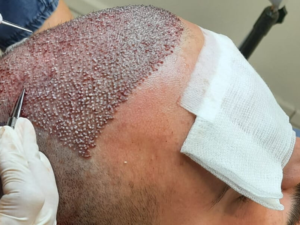
A graft is a small unit of tissue containing one or more hair follicles. During a hair transplant, healthy follicular units are taken from a donor area, usually the back or sides of the scalp, and placed into areas affected by hair thinning or baldness.
A single graft does not necessarily contain one hair. Depending on the follicular unit, it may contain one, two, three or sometimes more hairs.
This is why graft count and hair count are not the same thing.
For example, 2,000 grafts could contain considerably more than 2,000 individual hairs. The actual number depends on the patient’s natural follicular-unit distribution.
How Many Grafts Are Usually Needed for a Hair Transplant?
There is no single graft number that is right for everyone.
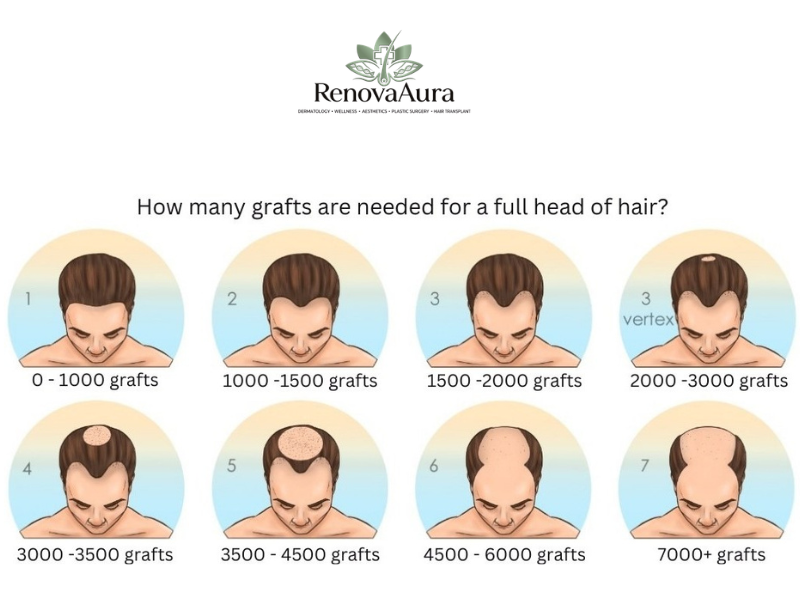
The required number may range from a relatively small number for a receding hairline or small thinning area to several thousand grafts when larger areas of hair loss need to be addressed.
The number depends mainly on:
- The extent and pattern of hair loss
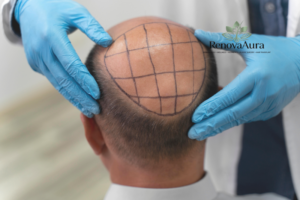
- The size of the area that needs coverage
- Existing hair density
- Donor hair density
- Hair thickness and texture
- The patient’s age and future hair-loss pattern
- The desired level of coverage
- The design of the hairline
- The availability of healthy donor follicles
For patients with extensive hair loss, the treatment may need to be planned carefully to make the best use of the available donor hair. In some situations, more than one session may be considered.
How Does a Doctor Calculate the Number of Grafts?
Graft planning begins with a detailed assessment rather than a fixed formula.
1. Assessing Your Hair Loss Pattern
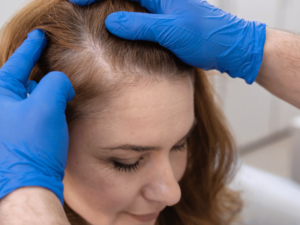
The doctor first looks at where hair has been lost and how advanced the thinning or baldness is.
The pattern and progression of hair loss help determine which areas should be prioritised. Rebuilding a natural-looking frontal hairline, for example, may require a different approach from filling the crown or adding density throughout the mid-scalp.
2. Examining the Donor Area
The donor area is extremely important because a hair transplant uses your existing hair follicles.
A doctor evaluates donor density, hair quality and the amount of hair that can potentially be harvested while maintaining a natural appearance in the donor area.
The goal is not simply to extract as many grafts as possible.
Good hair transplant planning is about using the donor supply responsibly while achieving meaningful coverage.
3. Considering Hair Thickness and Follicular Units
Hair characteristics can influence the visual result.
Thicker hair may provide greater visual coverage with fewer grafts, while finer hair may require more careful distribution to create the desired appearance.
The number of hairs contained within each graft also matters when planning density.
4. Planning the Hairline and Coverage Areas
Not every part of the scalp needs the same density.
The hairline needs careful placement of grafts to create a natural transition from the forehead to the denser hair behind it. Other areas may be planned differently depending on the patient’s pattern of hair loss and available donor hair.
A doctor therefore considers where the grafts will create the greatest improvement, rather than simply trying to fill every visible area equally.
5. Considering Future Hair Loss
Hair transplantation should be planned with the future in mind.
If existing, non-transplanted hair continues to thin after a transplant, the overall appearance can change over time. This is why a doctor should consider the patient’s current hair loss as well as the possibility of future progression.
A conservative and well-planned hairline may be more appropriate than using a very large number of grafts at an early stage.
Can You Get More Grafts for Better Density?
More grafts do not automatically mean a better result.
The number of grafts that can safely be used depends on the patient’s donor supply and the condition of the recipient area. Taking too many grafts from the donor region can affect its appearance and may reduce the options available for future treatment.
Similarly, placing grafts too densely may not always be appropriate.
The objective is to create natural-looking coverage while preserving the donor area for the long term.
How Many Grafts Are Needed for Different Areas?
The requirement can vary significantly from patient to patient, so numbers should not be treated as a fixed prescription.
A relatively small number may be enough for limited temple or hairline correction. More grafts may be required when treating the frontal scalp, mid-scalp or crown. Patients with advanced baldness may require a more comprehensive treatment plan.
This is why online graft calculators can provide only an estimate. They cannot replace an examination of your actual donor density, hair characteristics and pattern of hair loss.
RenovaAura also provides a Hair Graft Calculator designed to give patients a preliminary estimate based on hair-loss assessment factors. The final graft plan should be determined after clinical evaluation.
Does FUE or DHI Change the Number of Grafts You Need?
The technique does not automatically determine how many grafts a patient needs.
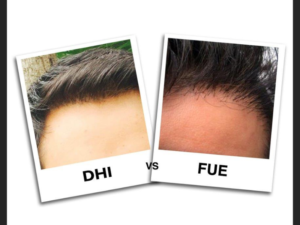
FUE and DHT/DHI are different hair restoration approaches, but the required graft count is primarily determined by the patient’s hair loss pattern, donor availability, treatment area and desired coverage.
The doctor may recommend a particular technique depending on the individual case.
At RenovaAura, available hair restoration approaches include FUE, DHT, FUT and other specialised procedures, with the treatment plan tailored to the patient’s requirements.
What Happens During a Hair Transplant Consultation?
A proper consultation allows the doctor to understand what is causing your hair loss and whether transplantation is appropriate.
The assessment may include:
- Reviewing your hair-loss history
- Examining the scalp and donor area
- Assessing hair density and characteristics
- Understanding your desired outcome
- Discussing your current and possible future hair loss
- Estimating the required grafts
- Discussing suitable treatment options
- Creating an individual treatment plan
This is important because not everyone with hair loss immediately needs a hair transplant. Depending on the cause and stage of hair loss, medical treatment or other approaches may sometimes be considered first.
Frequently Asked Questions
How many grafts are needed for a hair transplant?
The number varies according to the extent of hair loss, donor density, hair characteristics, treatment area and desired coverage. There is no universal graft number that applies to every patient.
Is 2,000 grafts enough for a hair transplant?
It can be enough for some patients, particularly when the area requiring treatment is limited. However, 2,000 grafts may not provide the same coverage for someone with more extensive hair loss. A doctor needs to assess the individual case before estimating the graft requirement.
Is 3,000 grafts a lot for a hair transplant?
Three thousand grafts can represent a substantial hair restoration procedure, but whether it is appropriate depends on the patient’s donor supply and the amount of scalp requiring coverage.
How many hairs are in one graft?
A graft can contain one or more hairs. The exact number varies between individuals and between different follicular units.
Can a doctor tell me exactly how many grafts I need?
A doctor can provide a much more accurate estimate after examining your scalp, donor area, hair density and pattern of hair loss. Online calculators can provide an initial estimate but should not be considered a final treatment plan.
Is more grafts always better?
No. The goal is not to use the maximum possible number of grafts. A good plan balances coverage with natural appearance and responsible use of the donor area.
The Right Graft Number Is the One That Fits Your Hair Loss
There is no magic number of grafts for a hair transplant.
The right number depends on your individual hair-loss pattern, donor hair, hair characteristics, treatment goals and future hair-loss risk. A personalised assessment is therefore more useful than choosing a graft number based on someone else’s experience.
At RenovaAura, Dr. Bhawna Bhardwaj provides doctor-led hair restoration assessment and personalised treatment planning, with the aim of creating natural-looking results while considering long-term donor hair availability.
If you are unsure whether you need a hair transplant or want to understand how many grafts may be appropriate for your situation, the next step is a professional assessment rather than guessing from an online number.
Book a consultation with RenovaAura to discuss your hair loss and receive an individual treatment plan.
https://www.renovaaura.com/contact
https://www.renovaaura.com/gallery